
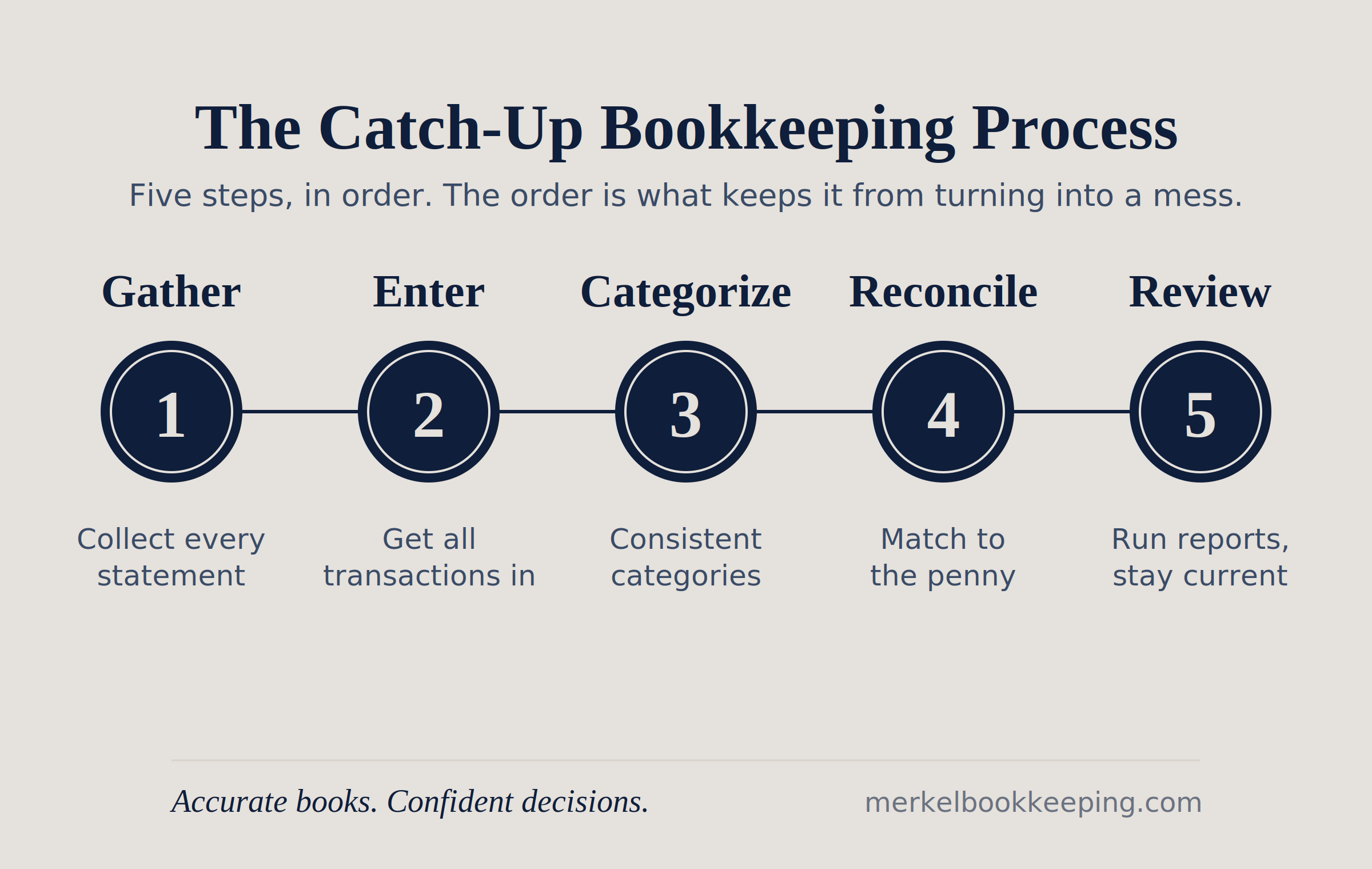
Falling behind on your books is fixable, no matter how far behind you are. The process is the same whether it's three months or three years: gather your records, get every transaction entered, categorize consistently, reconcile each account month by month, and review the results. This guide walks through each step and gives you an honest way to decide whether to do it yourself or hand it off.
First, take a breath: being behind is common and fixable
If your books have been sitting untouched for months, you're in very good company. Surveys of small business owners consistently find that about a quarter are behind on their bookkeeping at any given time, and most owners rank it among their least favorite tasks. You started a business to do the work you're good at, not to categorize transactions at midnight.
Here's the good news: catch-up bookkeeping is a well-worn path. Nothing about your situation will surprise a professional bookkeeper, and nothing about it is beyond fixing. The books don't judge. They just need attention, in the right order.
That order matters more than speed. Owners who try to catch up by jumping around, fixing a little here and a little there, usually end up more confused than when they started. Work through the steps below in sequence and the mess turns into a checklist.
Step 1: Gather your documents
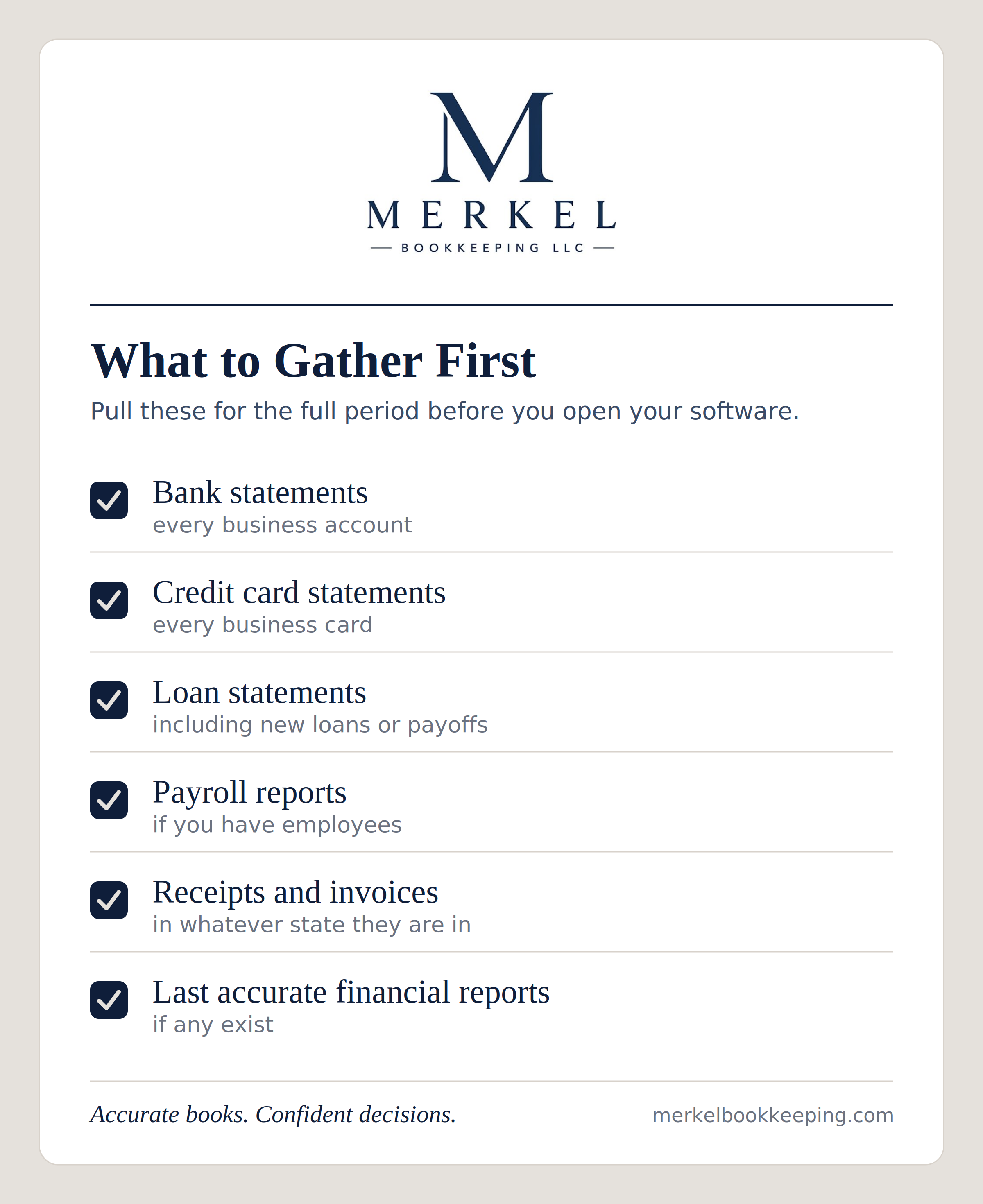
Before you touch your bookkeeping software, collect the raw materials. For the entire period you're behind on, you'll want:
- Bank statements for every business account
- Credit card statements for every business card
- Loan statements, including any new loans or payoffs
- Payroll reports, if you have employees
- Receipts and invoices, in whatever state they're in
- Your last set of accurate financial reports, if any exist
Don't worry if the receipts are a shoebox situation. Statements are the backbone of catch-up work; receipts fill in details. If you can download PDF statements from your bank for the whole period, you have most of what you need.
One tip that saves real time: pull statements for every account before you start entering anything. Discovering a forgotten credit card halfway through the project means redoing work.
Step 2: Get every transaction into your books
With documents in hand, the next job is completeness: every business transaction from the missing period needs to exist in your bookkeeping system.
If you use QuickBooks Online or similar software, connected bank feeds may have been quietly collecting transactions all along, which gives you a head start. For older periods the feed didn't cover, most banks let you export transactions as spreadsheet files that can be imported.
Work one account at a time, oldest month first. Finish the checking account before you start the credit card. Trying to enter everything everywhere at once is how catch-up projects stall.
At this stage, resist the urge to perfect anything. You're loading the truck, not organizing the garage.
Step 3: Categorize transactions consistently
Now every transaction needs a category, and the keyword is consistency. If fuel was "Vehicle Expenses" in January, it should not become "Auto" in June and "Travel" in October. Inconsistent categories are why so many catch-up projects produce reports that still don't make sense.
A few rules of thumb keep this step sane:
- Use a short list of categories that mirrors how you actually run your business
- When in doubt, categorize by what the purchase was for, not just who you bought it from
- Don't dump things into Miscellaneous; a category you have to guess about is a question you'll face again at tax time
- Keep personal spending flagged and separate as you go
Step 4: Reconcile every account, month by month
Reconciliation is the step that turns "I entered everything" into "everything is right." For each account, each month, you compare your books against the bank statement until they match to the penny.
This is where you catch the duplicates the bank feed created, the missing checks, the deposit that was recorded twice. Skipping reconciliation and calling the project done is the most common DIY catch-up mistake, and it means you still can't trust your reports.
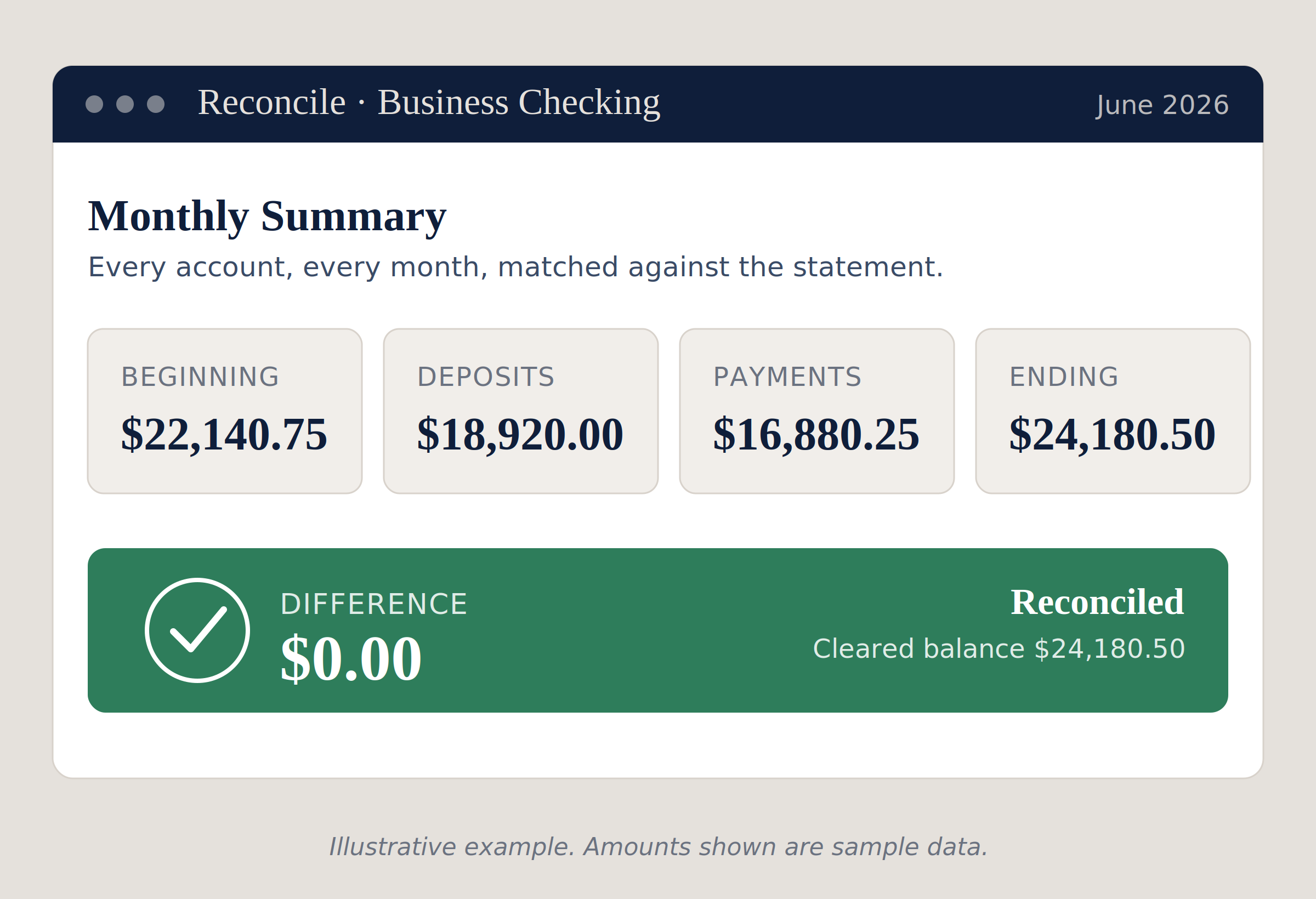
Go in order: oldest month first, one account at a time. Each month you reconcile becomes solid ground for the next.
Step 5: Review the results and lock it down going forward
When every month is reconciled, run your reports: profit and loss, balance sheet. Read them with fresh eyes. Do the numbers pass the smell test? Does revenue look like what you actually collected? Any negative balances or categories that make no sense are threads worth pulling before you declare victory.
Then, and this is the step that matters most, decide how the books will stay current. Catch-up work you have to repeat next year wasn't a fix, it was a loop. Whether that means a monthly appointment with yourself or handing the routine to a professional, pick the system you'll actually keep.
Catch-up or cleanup? How to tell which one you need
The two terms get used interchangeably, but they're different jobs:
- Catch-up records what's missing. The books stopped; the business didn't.
- Cleanup fixes what's wrong. Transactions were entered, but entered badly: miscategorized, duplicated, never reconciled.
Many businesses need both, because books that fell behind were often drifting before they stopped. If your existing entries don't reconcile or your old reports never made sense, plan for cleanup too. Here's what a bookkeeping cleanup actually involves.
DIY or hire it out? An honest framework
You can absolutely catch up your own books. Whether you should depends on a few honest questions:
- How far behind are you? A month or two is a weekend project. A year or more is a real undertaking.
- How many transactions flow through the business? A consultant with twenty transactions a month is a different project than a contractor running crews, materials, and three credit cards.
- Is anything wrong, or just missing? If past entries are wrong, the project needs cleanup skills, not just data entry.
- What is your time worth right now? Every evening spent on old transactions is an evening not spent on the work that pays you.
If you're a few months behind with simple finances and a free weekend, go for it, using the steps above. If you're a year behind, juggling accounts, or already dreading it, handing it off is usually the faster and, honestly, cheaper path once your own hours are counted.
How Merkel Bookkeeping handles catch-up projects
Catch-up and cleanup work is one of the core things we do at Merkel Bookkeeping. It starts with a diagnostic look at your books, so you get a clear picture of what's missing, what's wrong, and what it will take to fix, before any work begins. From there, we bring every month current, reconcile every account, and hand you reports you can finally trust. Most clients then roll into monthly bookkeeping so they never fall behind like this again.
If you're behind and tired of thinking about it, book a free intro call. No judgment, just a plan.
FAQ
How long does catch-up bookkeeping take?
It depends on how many months are missing and how many transactions each month holds. A few months for a simple business can be done in days; a year or more with multiple accounts typically takes a few weeks. A diagnostic review gives you a real estimate instead of a guess.
Can I do catch-up bookkeeping myself?
Yes, especially if you're only a few months behind and your finances are simple. Follow the steps in order: gather documents, enter everything, categorize consistently, reconcile every month. If entries are wrong (not just missing) or the volume is high, a professional will get it done faster and more accurately.
What documents do I need to catch up on my books?
Bank statements, credit card statements, and loan statements for the full missing period, plus payroll reports if you have employees, and whatever receipts and invoices you have. Statements matter most.
What happens if I stay behind on bookkeeping?
You lose visibility into whether the business is actually making money, tax preparation becomes slow and expensive, and things like loan applications get harder because you can't produce current reports. The pile also only grows.
Is catch-up bookkeeping the same as a cleanup?
No. Catch-up records transactions that were never entered; cleanup corrects entries that exist but are wrong. Many businesses need both, and a good bookkeeper will tell you which after looking at your books.